Precariousness on the Edge
14th July 2026
At the Alexander Technique Congress in Dublin last year, I enjoyed spending time in the work-exchange room. As you’d expect there were lots of people being taken in and out of chairs and lying on their backs on tables. It was heartening to see so many people exploring the work together – clearly there’s life in the AT yet! (I couldn’t help thinking that there's a slightly amusing side to this as well — if you weren't in the know, you'd think we're a strange lot…).
Anyway, while those two traditional procedures are wonderful, there's a lot more we can explore around lying down. One thing that I play with often – both on my own and with students – is lying on one's side. I like this because it gives us a chance to explore some of the factors we need to manage in our relationship with gravity when we’re upright – balance, precariousness and our relationship with the ground – but in a much gentler way, and with much lower stakes. If we fall when we are standing we could hurt ourselves badly. If we fall off our 'edge' onto our front or back when we're on the ground, on the other hand, there's no harm done. And yet our system is still aware of the slight precariousness that exists when we're lying on our side rather than our back or front, and this gives us a chance to explore how we react in the face of being slightly insecure. In time we can take this learning with us into uprightness, and it may help us to find a new freedom there too.
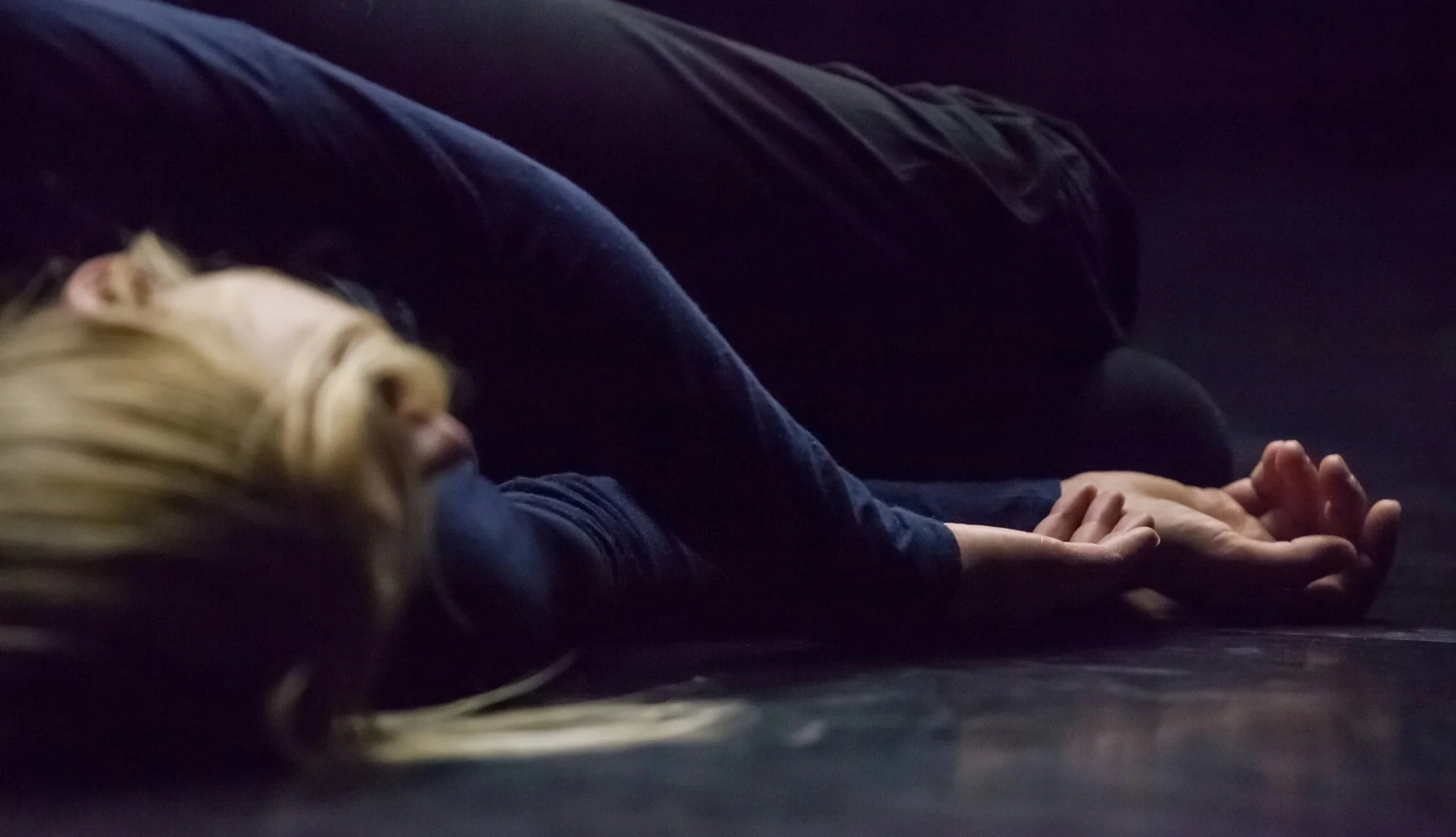
Say you want to explore this on your own. You can begin by lying down on one side with your legs in line with your body, one on top of the other and only very slightly bent, your top arm lying along your torso, so you're a little like a ruler on its edge. You can put your lower arm under your head to support it if this is more comfortable. I think it's nicer to lie on the floor for this rather than a table. You can fall off tables, but no matter how far you roll you won't fall off the floor, so using the floor takes an additional slight stressor out of the equation.
For many people, this slight instability is enough to induce quite a lot of conscious or unconscious holding and bracing to stay in balance. We can begin just by noticing this in ourselves. It is often particularly noticeable in our arms and shoulders. For example, we may find that we brace the lower shoulder and arm, using the arm's contact with the ground to increase our base of support and lock us into position. We may also notice that we tend to hold in with legs, hips and pelvis particularly, or elsewhere.
The first thing to realise about this tension is that some of it may be a necessary, automatic response to the details of the position we're in. We may have placed our limbs, torso and head in positions in which they – or we as a whole – will topple if we don't hold on. We can begin by exploring this. Start just by wondering and observing, through the lens of a bit of common-sense mechanics. Perhaps we notice our torso is leaning forward a bit, or our top leg is placed awkwardly on top of the other, or something else. We can just experiment for a while. Often even very small adjustments can allow bracing and holding to spontaneously let go.
We can also be aware of how we may be responding to the slight threat of falling that this unstable position can evoke. Are we holding our breath, or concentrating – being a bit over-intent? Are we holding our joints braced even where it's not necessary for us to stay balanced, just to help us feel a bit more secure? If we notice these kinds of habitual responses and holdings, we can think about gently stopping with them – allowing the breath to breathe, letting our attention open and widen, letting braced joints be free. No pressure or drama, just a gentle request for them to stop.
All this is a truly exploratory process, something to be interested in and take time with. We can deepen it further by asking a teacher or friend to help. They can kneel on the floor behind us, putting one hand on our pelvis and the other very lightly on our shoulder, and then rock us gently a little way forwards and back. This slightly raises the feeling of danger of falling as they take us slightly off balance, first one way, then the other. We won't fall though, so long as they don't let us! So we can play with allowing freedom and ease in our breath, our attention and our musculature in the face of this mild added stimulus to tighten and hold for security.
Later, if we explore this over a few days or weeks, we may find that we are gaining an increasing ability to let go and allow in the face of the more serious threat to stability and safety we experience in more upright positions like sitting and standing. Perhaps in the workshare room at the next Congress, alongside the people lying semi-supine and going in and out of chairs, there could be a new cohort of intrepid edge explorers!
You can read a lot more about these kinds of exploratory processes and the physiology, psychology and emotions behind them in my book Ease and Skill: A User's Guide to the Self. You can find out more about it here, or see it on Amazon, or Barnes and Noble in the US, here.